World POTS Day: what science knows today and why movement matters
Today is World POTS Day, a date to make visible a condition that many people live with in silence for years. Dizziness on standing up, a heart that races for no obvious reason, fatigue that a bad night’s sleep doesn’t explain… and, far too often, the phrase “your tests are normal.” In this article we look at what POTS is, who it affects, why it is so hard to diagnose and which measures are currently backed by science.
1. What is POTS?
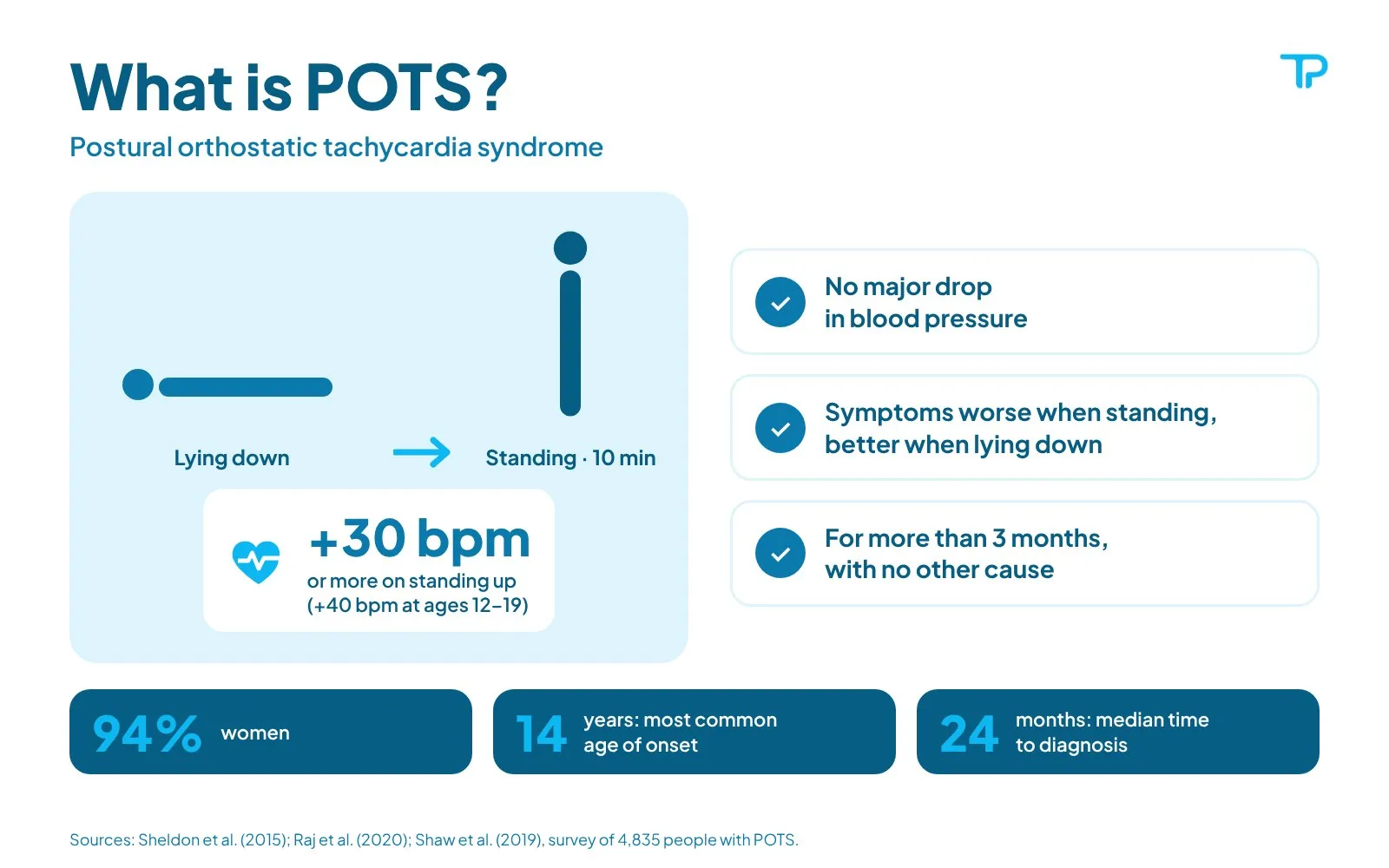
POTS stands for postural orthostatic tachycardia syndrome. It is a chronic, often disabling disorder of autonomic regulation: when moving from lying down to standing, heart rate rises excessively without a drop in blood pressure, and symptoms of orthostatic intolerance appear, such as dizziness, palpitations, fatigue or difficulty concentrating [1].
International consensus statements define POTS using specific criteria [2, 3]:
- A heart rate increase of 30 beats per minute or more within the first 10 minutes of standing or on a tilt-table test (40 bpm or more at ages 12–19).
- No orthostatic hypotension, meaning no major drop in blood pressure on standing.
- Symptoms that get worse when standing and better when lying down, present chronically (more than 3 months).
- No other cause that explains the tachycardia, such as acute dehydration, anaemia or certain medications.
A key point: POTS is not a single disease but a heterogeneous syndrome that may involve different underlying mechanisms [3]. That is why two people with POTS can experience it very differently.
2. Who does it affect, and what is it like?
The largest survey to date, including 4,835 people with a diagnosis, showed that POTS mainly affects women (94%) of childbearing age, and that about half first had symptoms in adolescence, with 14 as the most common age of onset [4].
The most commonly reported symptoms were light-headedness (99%), tachycardia (97%), feeling about to faint (94%), headache (94%) and difficulty concentrating (94%) [4]. It is not “just the heart”: it is a multisystem condition that often comes with other diagnoses.
Onset also frequently follows an immune stressor, such as a viral infection [1].
3. The long road to diagnosis
One of the toughest findings from the survey: people with POTS waited a median of 24 months for their diagnosis, and misdiagnosis was common. The good news is that this delay has been getting shorter over time [4].
The Canadian position statement also warns about the opposite mistake: labelling people as having POTS when they don’t meet the criteria, for example those with postural symptoms but no tachycardia, or with tachycardia that has another clear cause [3]. An accurate diagnosis matters, because it guides treatment.
If you recognise yourself in these symptoms, the first step is to talk with your healthcare team. A well-performed active stand test or tilt-table test can clarify a lot.
4. What science doesn’t know yet (and what it does)
It has to be said honestly: the mechanisms of POTS are still not fully understood, and there are no FDA-approved medications specifically for it. Various drugs are used for specific symptoms, but the evidence behind them is not strong [1].
That is why the US National Institutes of Health expert consensus states that management begins with patient education and non-drug measures [1].
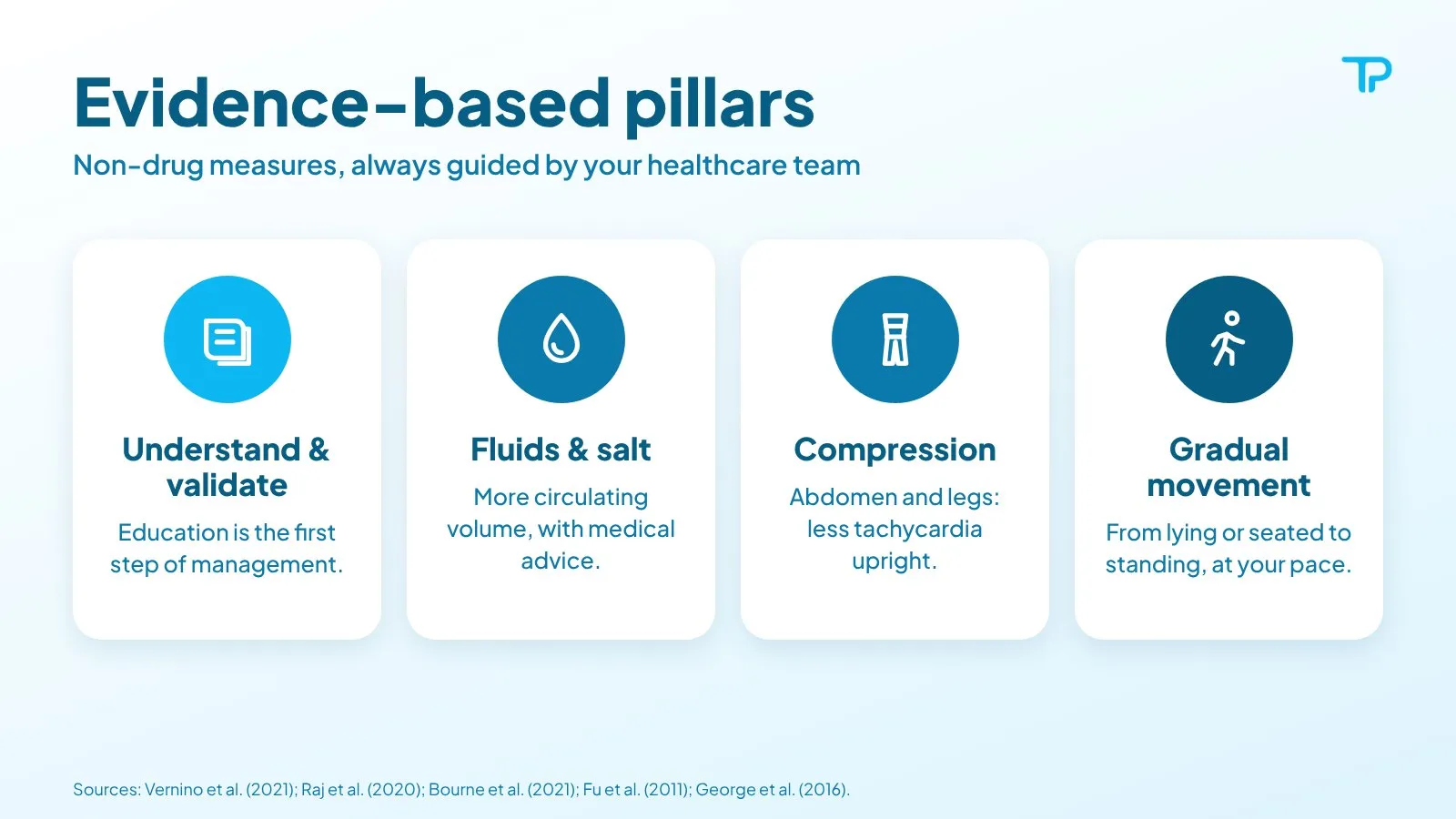
Among these measures, guidelines include increasing fluid and salt intake to support circulating blood volume [2, 3]. This should be advised by your medical team, because it isn’t right for everyone (for example, if you have high blood pressure or kidney disease).
Compression is also supported by evidence. In a randomised trial with 30 people with POTS, an abdomen-and-leg compression garment lowered standing heart rate from 109 to 92 bpm on average and improved symptoms. Abdominal compression alone also helped, a useful option if the full garment isn’t well tolerated [5].
5. Exercise: from intolerance to movement that’s possible
Here lies one of the paradoxes of POTS: exercise is hard, sometimes very hard, and yet it is one of the best-supported interventions.
In a clinical study, 19 people with POTS first received a drug (propranolol) or placebo and then completed 3 months of exercise. Both the drug and exercise lowered standing heart rate, but only exercise improved quality of life, in both physical and social functioning [6].
That program was then taken into everyday clinical practice. In an international registry, 251 people started a 3-month plan supervised by their physician: gentle to moderate aerobic exercise that began in reclined positions (such as a recumbent bike, rowing or swimming) and progressed gradually to upright exercise, 3 to 5 times a week, plus strength work and increased fluids and salt [7]. Among those who completed the program:
- 71% no longer met the criteria for POTS.
- The rise in heart rate on standing fell from 46 to 23 bpm on average.
- Quality of life improved substantially, and the effect lasted in those followed for 6 to 12 months [7].
There is a nuance we don’t want to hide: only 103 of the 251 people completed the program [7]. Moving with POTS isn’t easy, which is why progression is key: start where your body allows, match the intensity to your energy each day and move forward without rushing. If symptoms increase at any point, lower your position or your level.
6. How to take part in World POTS Day
- Listen and validate. If someone close to you lives with POTS, “normal tests” don’t mean they aren’t feeling what they describe.
- Share evidence-based information. It helps shorten those 24 months of waiting.
- Talk with your healthcare team if you recognise these symptoms, rather than self-diagnosing.
- Start moving at your own pace, with a gradual plan matched to your energy.
This article is educational and does not replace assessment or individual care from your healthcare team.
In summary
 TRAINING
POTS
| Topic | What the evidence shows |
|---|---|
| What it is | A rise of 30 bpm or more on standing (40 bpm at ages 12–19), without orthostatic hypotension and with chronic symptoms |
| Who it affects | Mostly young women; about half start in adolescence |
| Diagnosis | Median of 24 months to diagnosis, with frequent misdiagnosis |
| Treatment | Starts with education and non-drug measures; there are no FDA-approved drugs for POTS |
| Compression | Abdomen-and-leg garment: standing heart rate from 109 to 92 bpm on average |
| Exercise | Gradual 3-month program: 71% of those who completed it no longer met POTS criteria |
POTS is real, common and manageable. The evidence supports starting by understanding the condition and adding movement gradually, from lying down to standing, at your own pace.
On World POTS Day, the most important message is this: what you feel has a name, an explanation and tools.
There is no single fix, but there is a science-backed path: understanding the condition, supporting blood volume and circulation, and getting back to moving little by little, respecting your energy each day.
Ready to put this into practice?
Training POTS turns the evidence into short videos organised by energy level, so you can move safely on good days and hard days.

Isabel Valdés is a physiotherapist with more than 12 years in rehabilitation, specialised in dysautonomia, POTS and heritable connective tissue disorders. She also lives with dysautonomia.
References
- Vernino, S., Bourne, K. M., Stiles, L. E., Grubb, B. P., Fedorowski, A., Stewart, J. M., Arnold, A. C., Pace, L. A., Axelsson, J., Boris, J. R., Moak, J. P., Goodman, B. P., Chémali, K. R., Chung, T. H., Goldstein, D. S., Diedrich, A., Miglis, M. G., Cortez, M. M., Miller, A. J., . . . Raj, S. R. (2021). Postural orthostatic tachycardia syndrome (POTS): State of the science and clinical care from a 2019 National Institutes of Health Expert Consensus Meeting – Part 1. Autonomic Neuroscience, 235, Article 102828.
- Sheldon, R. S., Grubb, B. P., Olshansky, B., Shen, W.-K., Calkins, H., Brignole, M., Raj, S. R., Krahn, A. D., Morillo, C. A., Stewart, J. M., Sutton, R., Sandroni, P., Friday, K. J., Hachul, D. T., Cohen, M. I., Lau, D. H., Mayuga, K. A., Moak, J. P., Sandhu, R. K., & Kanjwal, K. (2015). 2015 Heart Rhythm Society expert consensus statement on the diagnosis and treatment of postural tachycardia syndrome, inappropriate sinus tachycardia, and vasovagal syncope. Heart Rhythm, 12(6), e41–e63.
- Raj, S. R., Guzman, J. C., Harvey, P., Richer, L., Schondorf, R., Seifer, C., Thibodeau-Jarry, N., & Sheldon, R. S. (2020). Canadian Cardiovascular Society position statement on postural orthostatic tachycardia syndrome (POTS) and related disorders of chronic orthostatic intolerance. Canadian Journal of Cardiology, 36(3), 357–372.
- Shaw, B. H., Stiles, L. E., Bourne, K., Green, E. A., Shibao, C. A., Okamoto, L. E., Garland, E. M., Gamboa, A., Diedrich, A., Raj, V., Sheldon, R. S., Biaggioni, I., Robertson, D., & Raj, S. R. (2019). The face of postural tachycardia syndrome – insights from a large cross-sectional online community-based survey. Journal of Internal Medicine, 286(4), 438–448.
- Bourne, K. M., Sheldon, R. S., Hall, J., Lloyd, M., Kogut, K., Sheikh, N., Jorge, J., Ng, J., Exner, D. V., Tyberg, J. V., & Raj, S. R. (2021). Compression garment reduces orthostatic tachycardia and symptoms in patients with postural orthostatic tachycardia syndrome. Journal of the American College of Cardiology, 77(3), 285–296.
- Fu, Q., VanGundy, T. B., Shibata, S., Auchus, R. J., Williams, G. H., & Levine, B. D. (2011). Exercise training versus propranolol in the treatment of the postural orthostatic tachycardia syndrome. Hypertension, 58(2), 167–175.
- George, S. A., Bivens, T. B., Howden, E. J., Saleem, Y., Galbreath, M. M., Hendrickson, D., Fu, Q., & Levine, B. D. (2016). The international POTS registry: Evaluating the efficacy of an exercise training intervention in a community setting. Heart Rhythm, 13(4), 943–950.
Educational content. It does not replace an individual medical or physiotherapy assessment. Check with your healthcare team before starting a new exercise program.